Published on: 2025-08-29
Updated on: 2025-09-02
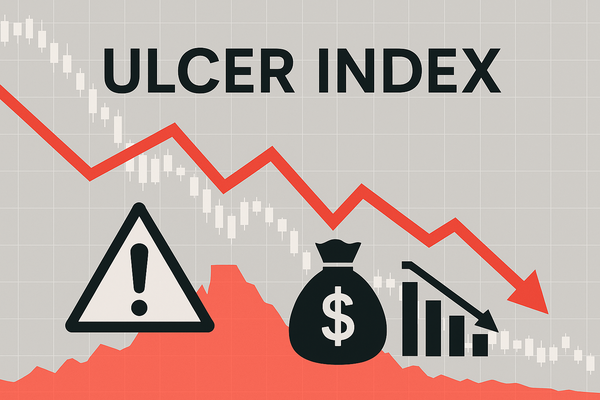
The Ulcer Index (UI) is a specialised risk measure that concentrates on downside risk by quantifying how deeply and for how long an investment's value falls below its previous peak. Unlike standard deviation, which treats all price movements equally, the Ulcer Index focuses solely on drawdowns—the declines that cause investor distress.
The calculation involves several steps: first, identifying the highest closing price during a chosen period (typically 14 to 20 days). Each day's percentage decline from this peak is measured. These declines are then squared to emphasise larger drops more heavily.
Afterwards, the average of these squared values over the period is taken, and the square root of that average yields the Ulcer Index as a percentage figure.
Simply put, the Ulcer Index quantifies both the magnitude and persistence of losses to give a clearer picture of potential investment “pain.”
Drawdowns can lead to emotional and financial stress, often causing investors to make impulsive decisions such as panic selling or abandoning solid strategies. Standard risk metrics may overlook this because they account for upward and downward price movements equally.
The Ulcer Index offers better insight into the risk that truly matters by measuring prolonged losses. This risk perspective helps traders compare investments more holistically, taking into account not only returns but also the likelihood and severity of investment drawdowns.
By understanding the Ulcer Index, investors can select strategies aligned with their risk tolerance, potentially avoiding uncomfortable losses and preserving capital. This metric is especially useful for those sensitive to emotional stress and focused on long-term discipline.
Imagine you manage a $50,000 portfolio evaluating two strategies over the past 12 months:
Strategy A: Gained 10% with a maximum drawdown of 25% lasting 3 months.
Strategy B: Returned 8% with a maximum drawdown of 8% lasting 2 weeks.
Calculating the Ulcer Index shows that Strategy A has a much higher value, reflecting longer and deeper losses, despite its higher return. This suggests more emotional and financial strain.
Strategy A's steep and extended drawdown indicates greater risk and potential stress.
Strategy B's smaller and shorter drawdown suggests a smoother ride and easier risk management.
A risk-conscious investor might favour Strategy B to protect capital and maintain psychological comfort.
Understanding the Ulcer Index helps traders weigh these nuanced differences beyond raw returns.
Confusing Ulcer Index with overall volatility; UI focuses solely on downside risk, ignoring positive price moves.
Assuming a low Ulcer Index means guaranteed profits; it only measures risk, not returns.
Neglecting drawdown duration, UI quantifies how long losses persist, which impacts investor psychology.
Believing Ulcer Index applies only to stocks, it effectively measures risk across asset classes, including forex, commodities, and portfolios.
| Term | Description |
|---|---|
| Drawdown | The percentage decline from a peak value, which is foundational for Ulcer Index calculation. |
| Maximum Drawdown | The largest drop in portfolio value during a specific time frame. |
| Standard Deviation | A common measure of overall price variability, including both rises and falls. |
| Sortino Ratio | A metric assessing risk-adjusted returns based on downside deviation, related to UI's focus. |
| Drawdown Duration | The time period an investment remains below its earlier peak highlights the stress of losses. |
Advanced traders incorporate Ulcer Index insights for enhanced risk management:
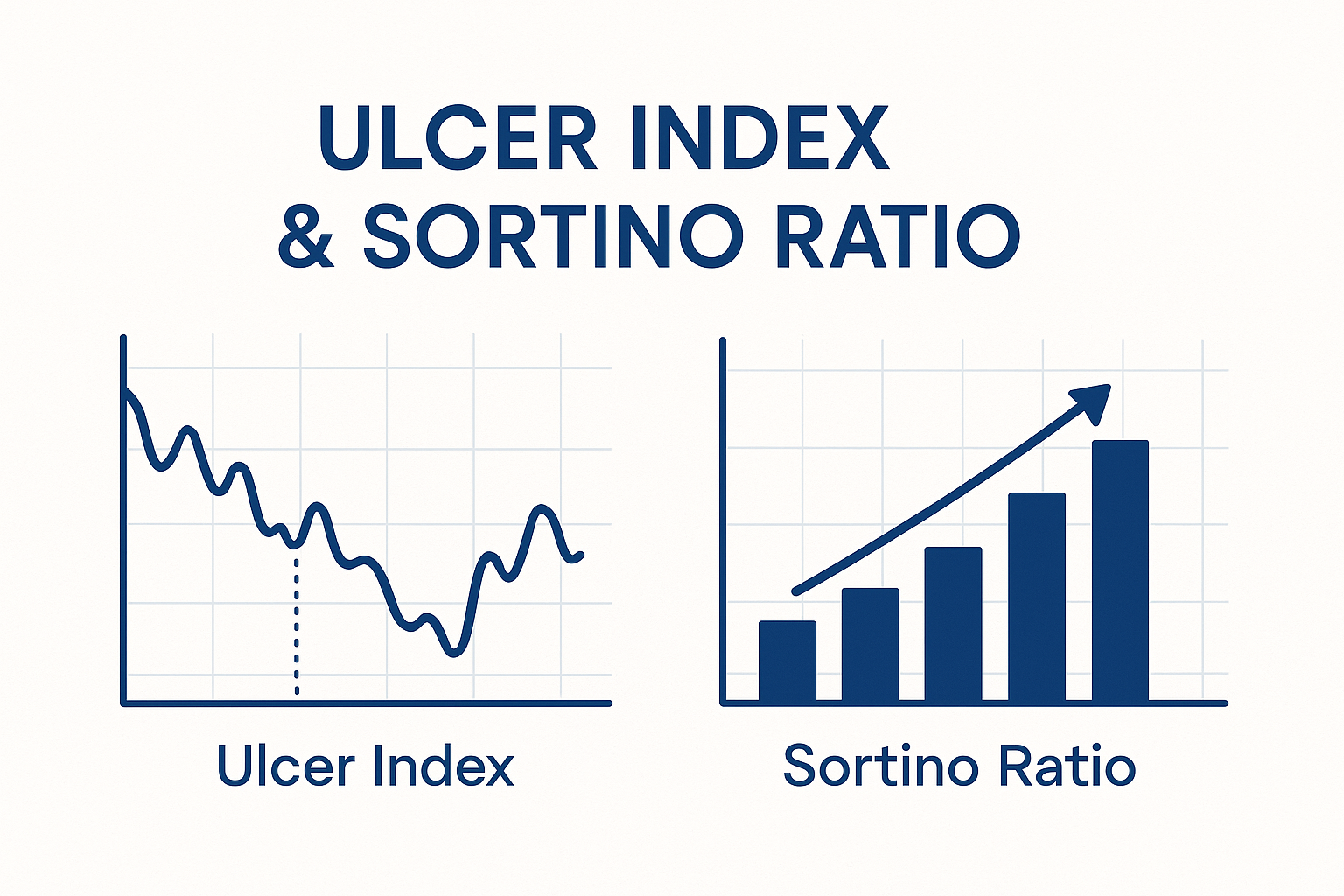
Pair UI with the Sortino ratio to evaluate returns relative to downside risk.
Track UI trends over time; rising UI values may signal increased risk, prompting tactical portfolio adjustments.
Base position sizing on UI metrics, reducing exposure to assets with rising drawdown stress.
Combine UI assessments with drawdown duration analysis to align trading plans with psychological comfort and risk tolerance.
Use UI to shape portfolio construction, favouring strategies with lower and more stable drawdown profiles for long-term discipline.
The Ulcer Index offers a refined lens for evaluating investment risk by highlighting the depth and duration of losses that affect investors most. Incorporating it alongside other metrics enhances trader understanding, supporting smarter decisions and more resilient portfolios.