Published on: 2025-08-29
Updated on: 2025-09-02

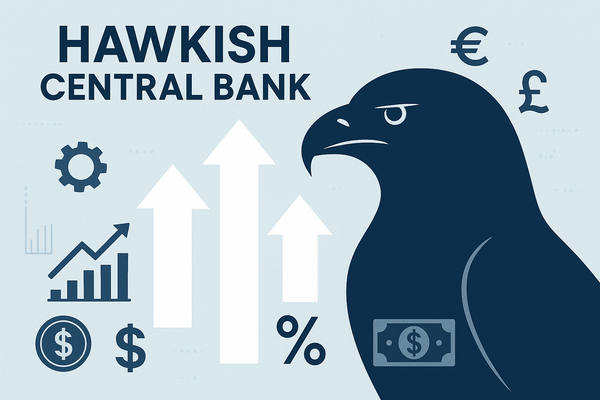
In finance, hawkish describes a central bank or policymakers focused on fighting inflation by tightening monetary policy. This often involves raising interest rates or reducing the money supply to cool borrowing and spending. The term comes from the idea of “hawks” being aggressive or vigilant in controlling inflation, contrasting with “doves,” who prioritise growth and lower rates.
A hawkish stance signals that the central bank is concerned about rising prices and aims to prevent inflation from accelerating. By increasing interest rates, borrowing costs for consumers and businesses rise, which typically reduces spending and investment. This cooling effect can slow economic growth, lower unemployment growth, and reduce corporate profits.
Financial markets react strongly to hawkish signals. Stocks sensitive to borrowing costs may fall as profit prospects dim, while bond yields often rise as investors demand higher returns. Currency markets also shift as higher interest rates attract foreign capital, strengthening the currency.
Understanding hawkish policies helps investors and traders anticipate these shifts, allowing smarter risk management and opportunity spotting.
When a central bank turns hawkish:
Mortgage rates increase, making home loans more expensive for buyers.
Business borrowing costs rise, often delaying expansions or new hires.
Consumers cut back on large purchases, reducing demand for cars, appliances, and other financed items.
Stock valuations adjust as higher borrowing costs and slower earnings growth weigh on prices.
Bond yields climb, causing existing bond prices to fall.
The currency often strengthens, drawing international investment but potentially hurting exporters.
For example, if you have $10,000 invested in stocks affected by interest rates, a hawkish move might slow earnings growth and lead to a drop in stock prices. Meanwhile, bond investors could see yields rise, influencing fixed-income portfolio values.
Understanding these effects allows traders and investors to adjust portfolios, hedge risks, or seek new opportunities.

Hawkish always means an economic recession is imminent. While hawkish policies can cool growth, recessions depend on many factors.
Hawkish means rates rise immediately. Sometimes, hawkish language signals possible future action rather than instant change.
Only central banks can be hawkish. Investors and economists also use the term, but it typically refers to official monetary policy.
Hawkish policies hurt all investments. Some sectors, like financials, may benefit from rising rates, and currency traders may find opportunities.
| Term | Description |
|---|---|
| Dovish | Contrasts with hawkish—focuses on supporting growth with low rates. |
| Interest Rate | The cost of borrowing money, heavily influenced by central banks. |
| Inflation | The rise in general price levels that hawkish policies aim to control. |
| Quantitative Tightening | Reducing the money supply by shrinking the central bank's asset holdings. |
Experienced traders watch hawkish signals carefully:
Hawkish rhetoric may cause sharp moves in bond yields, currencies, and stocks, creating both risk and trading opportunities.
Market timing around hawkish-driven rate hikes requires vigilance on economic data and policy communication nuances.
Some sectors outperform during rate hikes, notably banks and financial institutions, while others, like utilities, may lag.
Monitoring global central banks' hawkish moves is crucial for managing cross-border portfolio risks due to shifting capital flows and currency values.
Knowing what hawkish means and how it affects the economy empowers traders and investors to better anticipate interest rate cycles, adjust strategies, and manage risk effectively.


World's Best Broker










EBC Financial Group is a co-brand shared by a group of entities
including:
EBC Financial Group (SVG) LLC is authorized by the St.Vincent and the
Grenadines Financial Services Authority(SVGFSA),and the company
registration number is 353 LLC 2020, with registered address at Euro
House, Richmond Hill Road, Kingstown, VC0100, St. Vincent and the
Grenadines.
Other Relevant Entities
EBC Financial Group (UK) Limited is authorised and regulated by the
Financial Conduct Authority. Reference Number: 927552. Website: www.ebcfin.co.uk
EBC Financial Group (Cayman) Limited is licensed and regulated by the
Cayman Islands Monetary Authority (Number: 2038223). Website:
www.ebcgroup.ky
EBC Financial (MU) Limited is licensed and regulated by the the
Financial Services Commission, Mauritius (License Number GB24203273)
with registrated address at 3rd Floor, Standard Chartered Tower,
Cybercity, Ebene, 72201, Republic of Mauritius. Website for this entity
is maintained separately.
EBC Financial Group (Comoros) Limited is authorised by The Autonomous
Island of Anjouan, Union of Comoros Offshore Finance Authority with
License number L 15637/EFGC, with registered office address at Hamchako,
Mutsamudu, Autonomous Island of Anjouan, Union of Comoros.
EBC Financial Group (Australia) Pty Ltd (ACN: 619 073 237) is authorised
and regulated by the Australian Securities and Investments Commission
(Number: 500991). EBC Financial Group (Australia) Pty Ltd is a related
entity of EBC Financial Group (SVG) LLC. The two entities are managed
separately. The financial products and services offered on this website
are NOT provided by the Australian entity and no recourse against the
Australian entity is available.
EBC Group (Cyprus) Ltd, faciliates payment services to the licensed and
regulated entities within the EBC Financial Group strucutre, registered
under the Companies Law of Republic of Cyprus with the number HE 449205,
registered office address at 101 Gladstonos, Agathangelou Business
Centre, 3032 Limassol, Cyprus.
Business Address: The Leadenhall Building, 122 Leadenhall Street, London, United Kingdom, EC3V 4AB. Email Address :cs@ebc.com . Telephone : +44 20 3376 9662
Regional Restrictions:
EBC does not offer any services to citizens and residents of certain
jurisdictions including: Afghanistan, Belarus, Burma (Myanmar), Canada,
Central African Republic, Congo, Cuba, Democratic Republic of the Congo,
Eritrea, Haiti, Iran, Iraq, Lebanon, Libya, Malaysia, Mali, North Korea
(Democratic People's Republic of Korea), Russia, Somalia, Sudan, South
Sudan, Syria, Ukraine (including Crimea, Donetsk, and Luhansk Regions),
the United States, Venezuela, and Yemen.
Any Spanish on this website is for LATAM only and is not designated for
anyone in European Union or Spain For more information, please check out
our FAQs.
Any Portuguese on this website is for Africa only, and is not designated
for anyone in European Union or Portugal or Brazil. For more
information, please check out our FAQs.
Compliance Disclosure:The website can be accessed globally and is not specific to any entity. Your actual rights and obligations will be determined based on the entity and jurisdiction that you choose to be regulated.There may be local laws and regulations which prohibit or limit your rights to access, download, distribute, disseminate, share or otherwise use any or all of the documents and information published on this website.
Risk Warning: Trading Contracts for Difference (CFDs) are complex financial instruments and come with a high risk of losing money rapidly due to leverage. Trade on margin carries a high level of risk and may not be suitable for all investors. Before deciding to trade Forex and CFDs, you should carefully consider your trading objectives, level of experience and risk appetite. The possibility exists that you could sustain a loss of some or all of your initial trading capital. We recommend that you seek independent advice and ensure you fully understand the risks involved before making any investment decision. Please read the relevant risk disclosure statements carefully before trading.