Published on: 2025-07-14
The Japanese yen continues to weaken sharply as political uncertainty, stagnant trade negotiations with the United States, and mounting fiscal concerns weigh on investor sentiment. With the House of Councillors election scheduled for 20 July, market participants are increasingly positioning for further yen depreciation, with volatility expected to rise in the coming weeks.
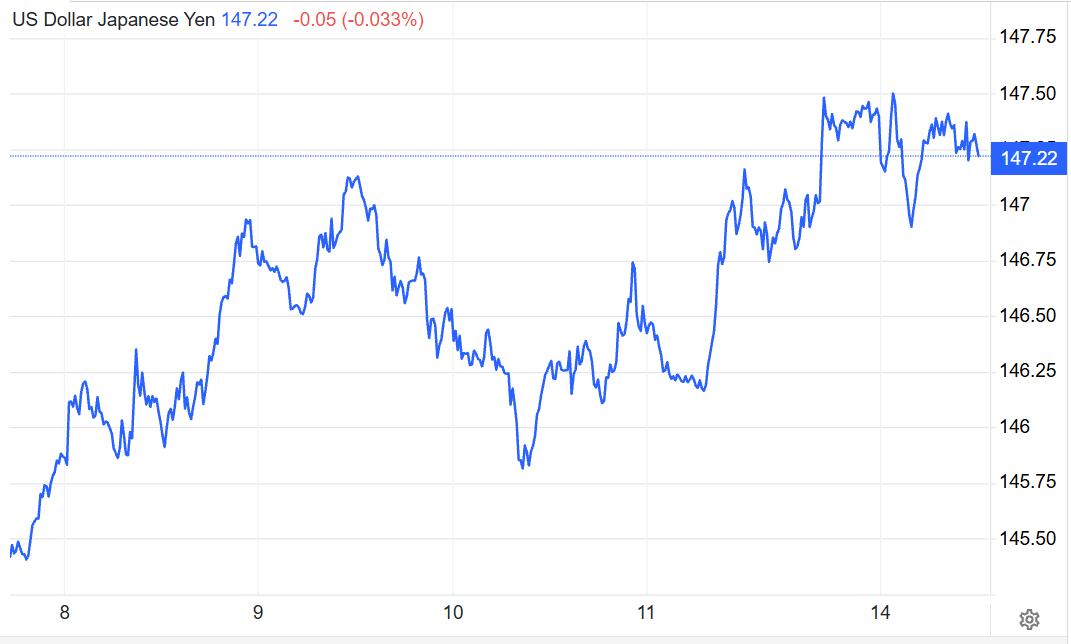 As of 14 July, the USD/JPY pair was trading at 147.57. approaching the psychologically significant 148 level. This movement comes amid growing expectations that the Japanese yen could weaken even further if political risks intensify and macroeconomic fundamentals remain under pressure.
According to data from CME Group's central limit order book, bullish option contracts on the USD/JPY now outnumber bearish contracts by more than two to one, highlighting the market's strong bias toward continued yen weakness. Option traders are positioning for a move towards the 200-day moving average of 149.71. a key technical resistance level identified by Graham Smallshaw, Senior Spot FX Trader at Nomura Securities.
The backdrop to the yen's slide is multifaceted. Progress in US–Japan trade talks remains limited, adding strain to bilateral economic relations. Furthermore, US President Donald Trump recently announced that broad tariffs on Japanese goods would rise to 25% starting 1 August, injecting fresh uncertainty into Japan's export outlook.
At home, Japan is facing significant political tension ahead of the upper house elections. Latest polling data suggests Prime Minister Shigeru Ishiba’s ruling coalition may lose its majority in the House of Councillors. Should this happen, Ishiba may be forced to form coalitions with smaller, fiscally loose parties, which could push for more aggressive stimulus and monetary easing measures.
The prospect of additional fiscal stimulus, although potentially beneficial for short-term domestic growth, is raising long-term debt sustainability concerns among investors. According to strategists at HSBC, the yen's recent trajectory shows a positive correlation with Japan's 30-year government bond yield and a steepening yield curve. These moves suggest that market participants are expecting looser fiscal policy—often negative for currency stability.
Citigroup's Head of Japan Markets, Akira Hoshino, added that institutional funds have been increasing long USD/JPY positions in anticipation of the election result. Traders now believe that, regardless of the outcome, the yen is likely to underperform against most major currencies, especially if the Bank of Japan (BoJ) is forced to delay or abandon its rate normalisation plans.
The uncertain election outlook and deteriorating economic fundamentals appear to have dealt a blow to any near-term plans by the BoJ to raise interest rates. Chief Bond Strategist Naomi Muguruma at Mitsubishi UFJ Morgan Stanley Securities warned that Japan should prepare for prolonged political instability and market volatility, further discouraging the central bank from tightening policy.
With global investors already cautious due to a wider slowdown in Asia and geopolitical friction in the Pacific region, the yen is now widely seen as a structurally weak currency in the near to medium term.
The Japanese yen's recent decline is more than a short-term reaction to political news flow—it reflects a broader reassessment of Japan's fiscal path, monetary policy direction, and international positioning. As the country approaches a pivotal election on 20 July, investors should brace for elevated volatility in yen pairs, particularly if election results lead to coalition instability or extended policy uncertainty.
With USD/JPY threatening to breach the 148 level, and technical indicators pointing toward a possible test of 149.71. yen depreciation remains the base case for most institutional traders. For now, all eyes are on Tokyo—not only for ballots, but for the next big move in currency markets.
Disclaimer: This material is for general information purposes only and is not intended as (and should not be considered to be) financial, investment or other advice on which reliance should be placed. No opinion given in the material constitutes a recommendation by EBC or the author that any particular investment, security, transaction or investment strategy is suitable for any specific person.