Published on: 2025-11-05
A C-Book broker blends A-Book and B-Book models, balancing fair market access with smart risk management.
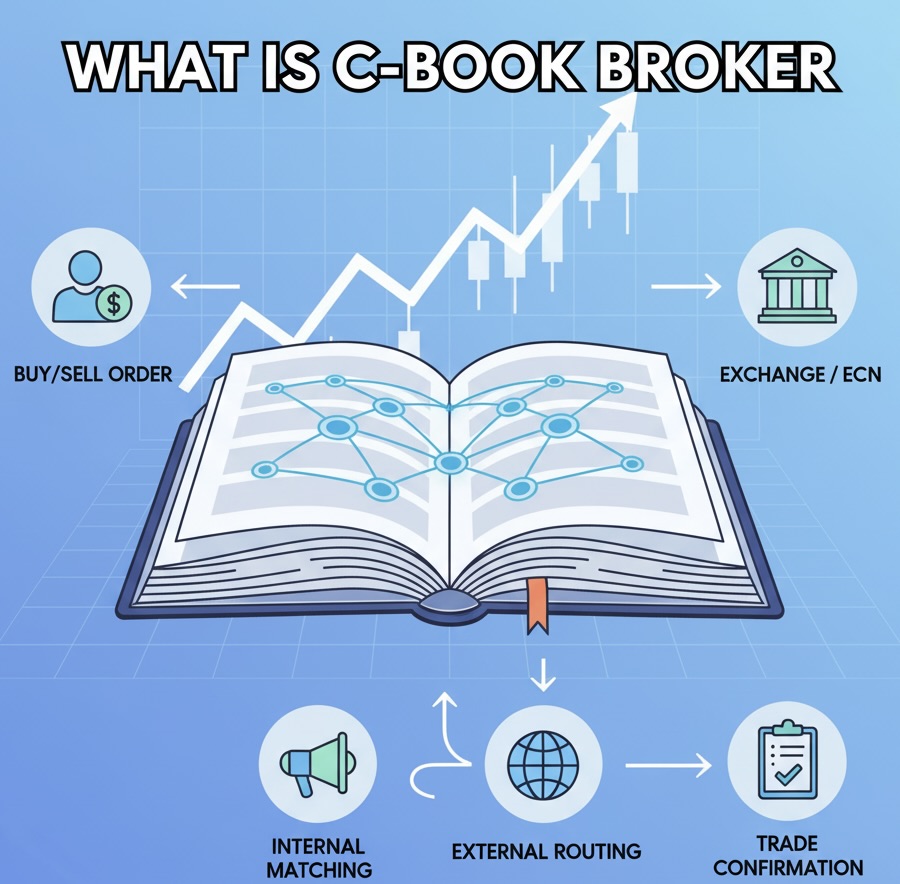
A C-Book broker is a less common hybrid model that combines features of both A-Book and B-Book systems.
It allows brokers to manage risk dynamically such as routing some trades to external liquidity providers (A-Book style) while keeping others in-house (B-Book style) based on factors like client performance, trade size, or market conditions.

A C-Book broker uses an adaptive risk management model where trades are categorized and handled differently.
Profitable or high-volume traders may have their orders sent directly to liquidity providers, while smaller or less consistent traders’ positions might be held internally.
This flexible setup helps brokers maintain profitability while offering efficient trade execution to a broad client base.
The C-Book model functions as a risk management bridge between A-Book and B-Book execution.
The broker’s system continuously analyzes trader behavior including win rate, trade duration, and volume to decide where to route each order.
For example, traders who consistently profit are often switched to A-Book routing, where trades are passed to the market to avoid broker losses.
Meanwhile, less experienced or infrequent traders may remain on the B-Book side, where their trades are managed internally.
This model gives brokers flexibility to balance exposure and protect their business during volatile periods, while still maintaining competitive pricing.
Imagine a forex broker using a C-Book setup.
A professional trader who regularly profits on EUR/USD trades gets routed through the A-Book path where their orders are sent directly to liquidity providers, ensuring real market execution and transparency.
A newer trader with small positions and irregular trades will stay on the B-Book side, and their orders are filled internally by the broker.
This system allows the broker to hedge selectively and manage risk efficiently across different trader profiles, maintaining profitability while still offering transparency to clients.
| Advantages / Benefits | Disadvantages / Risks |
|---|---|
| Balances risk between A-Book and B-Book execution | Can reduce transparency if routing rules aren’t disclosed |
| Offers flexibility during volatile markets | Traders may not know how their orders are handled |
| Supports both new and professional traders | Conflicts of interest may still exist for B-Book side |
| Allows brokers to manage exposure dynamically | Complex structure may confuse beginners |
A-Book Broker: Routes trades directly to liquidity providers for real market execution.
B-Book Broker: Holds client trades internally, potentially profiting from client losses.
Hybrid Model: Combines both A-Book and B-Book methods to optimize risk management.
Liquidity Provider: A bank or institution offering buy/sell quotes to brokers.
It depends. A C-Book broker balances the pros and cons of both systems, offering flexibility but sometimes less transparency.
Most brokers don’t advertise this openly, but you can review their execution policy or ask about how they manage client order flow.
To manage risk efficiently and routing profitable traders to the market (A-Book) and managing less consistent ones internally (B-Book).
A C-Book broker blends A-Book and B-Book models to manage risk adaptively. It routes trades based on trader performance and market conditions, balancing transparency and profitability.
While flexible, it’s less straightforward than pure A-Book or B-Book setups and may limit full visibility into trade execution.
Disclaimer: This material is for general information purposes only and is not intended as (and should not be considered to be) financial, investment or other advice on which reliance should be placed. No opinion given in the material constitutes a recommendation by EBC or the author that any particular investment, security, transaction or investment strategy is suitable for any specific person.



World's Best Broker












EBC Financial Group is a co-brand shared by a group of entities
including:
EBC Financial Group (SVG) LLC is authorized by the St.Vincent and the
Grenadines Financial Services Authority(SVGFSA),and the company
registration number is 353 LLC 2020, with registered address at Euro
House, Richmond Hill Road, Kingstown, VC0100, St. Vincent and the
Grenadines.
Other Relevant Entities
EBC Financial Group (UK) Limited is authorised and regulated by the
Financial Conduct Authority. Reference Number: 927552. Website: www.ebcfin.co.uk
EBC Financial Group (Cayman) Limited is licensed and regulated by the
Cayman Islands Monetary Authority (Number: 2038223). Website:
www.ebcgroup.ky
EBC Financial (MU) Limited is licensed and regulated by the the
Financial Services Commission, Mauritius (License Number GB24203273)
with registrated address at 3rd Floor, Standard Chartered Tower,
Cybercity, Ebene, 72201, Republic of Mauritius. Website for this entity
is maintained separately.
EBC Financial Group (Comoros) Limited is authorised by The Autonomous
Island of Anjouan, Union of Comoros Offshore Finance Authority with
License number L 15637/EFGC, with registered office address at Hamchako,
Mutsamudu, Autonomous Island of Anjouan, Union of Comoros.
EBC Financial Group (Australia) Pty Ltd (ACN: 619 073 237) is authorised
and regulated by the Australian Securities and Investments Commission
(Number: 500991). EBC Financial Group (Australia) Pty Ltd is a related
entity of EBC Financial Group (SVG) LLC. The two entities are managed
separately. The financial products and services offered on this website
are NOT provided by the Australian entity and no recourse against the
Australian entity is available.
EBC Group (Cyprus) Ltd, faciliates payment services to the licensed and
regulated entities within the EBC Financial Group strucutre, registered
under the Companies Law of Republic of Cyprus with the number HE 449205,
registered office address at 101 Gladstonos, Agathangelou Business
Centre, 3032 Limassol, Cyprus.
Business Address: The Leadenhall Building, 122 Leadenhall Street, London, United Kingdom, EC3V 4AB. Email Address :cs@ebc.com . Telephone : +44 20 3376 9662
Regional Restrictions:
EBC does not offer any services to citizens and residents of certain
jurisdictions including: Afghanistan, Belarus, Burma (Myanmar), Canada,
Central African Republic, Congo, Cuba, Democratic Republic of the Congo,
Eritrea, Haiti, Iran, Iraq, Lebanon, Libya, Malaysia, Mali, North Korea
(Democratic People's Republic of Korea), Russia, Somalia, Sudan, South
Sudan, Syria, Ukraine (including Crimea, Donetsk, and Luhansk Regions),
the United States, Venezuela, and Yemen.
Any Spanish on this website is for LATAM only and is not designated for
anyone in European Union or Spain For more information, please check out
our FAQs.
Any Portuguese on this website is for Africa only, and is not designated
for anyone in European Union or Portugal or Brazil. For more
information, please check out our FAQs.
Compliance Disclosure:The website can be accessed globally and is not specific to any entity. Your actual rights and obligations will be determined based on the entity and jurisdiction that you choose to be regulated.There may be local laws and regulations which prohibit or limit your rights to access, download, distribute, disseminate, share or otherwise use any or all of the documents and information published on this website.
Risk Warning: Trading Contracts for Difference (CFDs) are complex financial instruments and come with a high risk of losing money rapidly due to leverage. Trade on margin carries a high level of risk and may not be suitable for all investors. Before deciding to trade Forex and CFDs, you should carefully consider your trading objectives, level of experience and risk appetite. The possibility exists that you could sustain a loss of some or all of your initial trading capital. We recommend that you seek independent advice and ensure you fully understand the risks involved before making any investment decision. Please read the relevant risk disclosure statements carefully before trading.