 Summary:
As Indonesia enforces mining shutdowns in the protected Raja Ampat region, EBC Financial Group points to rising uncertainty in nickel markets.
While environmental advocates have largely welcomed the Indonesian government's move to preserve Raja Ampat, traders are now closely watching the ripple effects such policy shifts may trigger in global commodity markets.
Indonesia's nickel industry, accounting for 51% of the world's nickel production, is facing renewed uncertainty following sweeping government action to revoke nickel mining permits in the UNESCO-protected region of Raja Ampat.
In a landmark move to safeguard Raja Ampat's unique marine ecosystems, the Indonesian government revoked permits for four nickel mining companies operating in the area — a decision widely praised by environmental groups. However, one major project continues just outside the protected zone, while legal battles mount as companies seek to challenge the shutdowns and revive their permits.
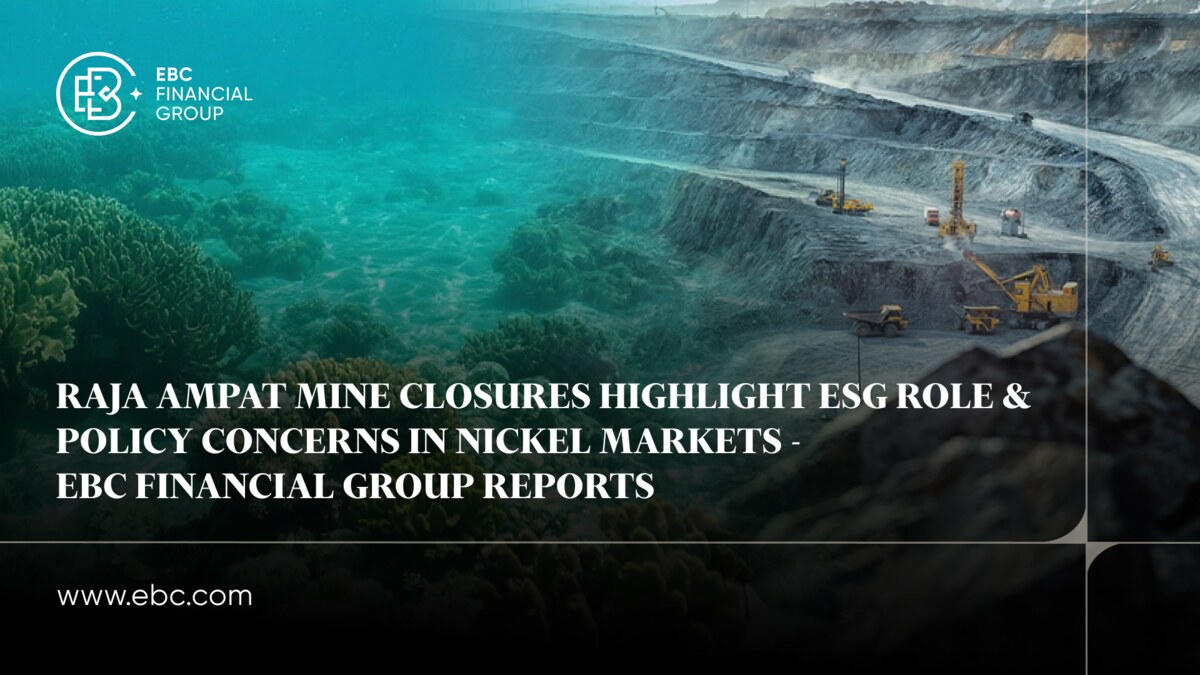
"The Raja Ampat case highlights the growing intersection of ESG factors, local community interests, and global market dynamics," said David Barrett, CEO of EBC Financial Group (UK) Ltd. "For traders and investors, this is a wake-up call that commodity markets — especially in critical sectors like nickel — can be highly sensitive to environmental policy pressures."
While Raja Ampat is not a major production zone, the decision is part of Indonesia's broader pivot toward stronger environmental and regulatory governance, a key signal for traders watching long-term policy shifts affecting commodity sectors.
Why Traders Should Care
"Traders need to stay alert not only to commodity volatility, but also to potential impacts on the rupiah, equities, and the country's broader ESG risk profile," said David Barrett, CEO of EBC Financial Group (UK) Ltd. For traders, nickel's current rebound may mask deeper volatility risks — especially as ongoing legal and policy shifts threaten to reshape supply-side expectations.
Nickel is also a key driver of Indonesia's trade surplus, contributing around 6.8% of total exports in 2024. Any decline in output due to permit shutdowns could reduce export revenues, adding pressure to the rupiah (USD/IDR) and widening the country's current account deficit. For traders, this represents a potential two-way risk: short-term currency volatility, and longer-term shifts in monetary policy assumptions. When legal uncertainty , and policy shifts hit this sector, price movements can be swift and unpredictable.
According to the Investing News Network, nickel prices plunged to five‑year lows in Q1 2025—briefly falling below US 15,000/metric ton—driven by oversupply from Indonesia and US tariff concerns, though they have since bounced back toward US 16,700/ton. This volatility highlights how quickly supply-side shocks and policy moves can whipsaw sentiment in the nickel market. The recent rebound has been largely driven by expectations of tighter supply and a more disciplined production outlook.
However, Indonesia's abrupt shutdowns in Raja Ampat introduce new uncertainty, not just in terms of volume, but also investor confidence and regulatory clarity. Any escalation in legal disputes or further reductions in nickel output could trigger another price surge, especially if markets reprice supply risks more aggressively.
With ESG-focused funds globally increasing their scrutiny of nickel sourcing, we advise traders to monitor both market fundamentals and evolving political signals — as these will likely shape price action ahead.
Indonesia, The Global Nickel Hub
In 2024, Indonesia produced an estimated 2.2 million metric tons of refined nickel, over half the global supply, cementing its position as the single most influential player in the global nickel market. This dominance means that any disruption in Indonesian output has immediate global repercussions, particularly for EV battery supply chains and stainless steel manufacturing, the latter of which still accounts for over two-thirds of global nickel demand.
While battery production continues to drive long-term demand, over two-thirds of global nickel consumption still supports stainless steel manufacturing. Roughly 75% of stainless steel grades require nickel to stabilise the alloy structure, making it indispensable to heavy industries in critical sectors like automotive, construction, food and beverage, medical equipment, oil and gas, aerospace, and energy infrastructure. Any sustained disruption in Indonesian supply could tighten availability across these verticals; raising input costs, slowing production, and fuelling broader inflationary pressures in industrial commodities.
Disclaimer: This material is for general information purposes only and is not intended as (and should not be considered to be) financial, investment or other advice on which reliance should be placed. No opinion given in the material constitutes a recommendation by EBC or the author that any particular investment, security, transaction or investment strategy is suitable for any specific person.

EBC Financial Group won Best Broker for Execution at the 2025 Professional Trader Awards, highlighting its fast execution and trader-focused platform upgrades.
2025-12-08
EBC Financial Group announces regulatory approval of its South African subsidiary, positioning the firm for future market access in South Africa's growing financial services sector.
2025-11-25
EBC Financial Group highlights how Indonesia is monetising high‑integrity carbon assets, shaping sustainable investment opportunities.
2025-11-20


