Published on: 2025-07-04
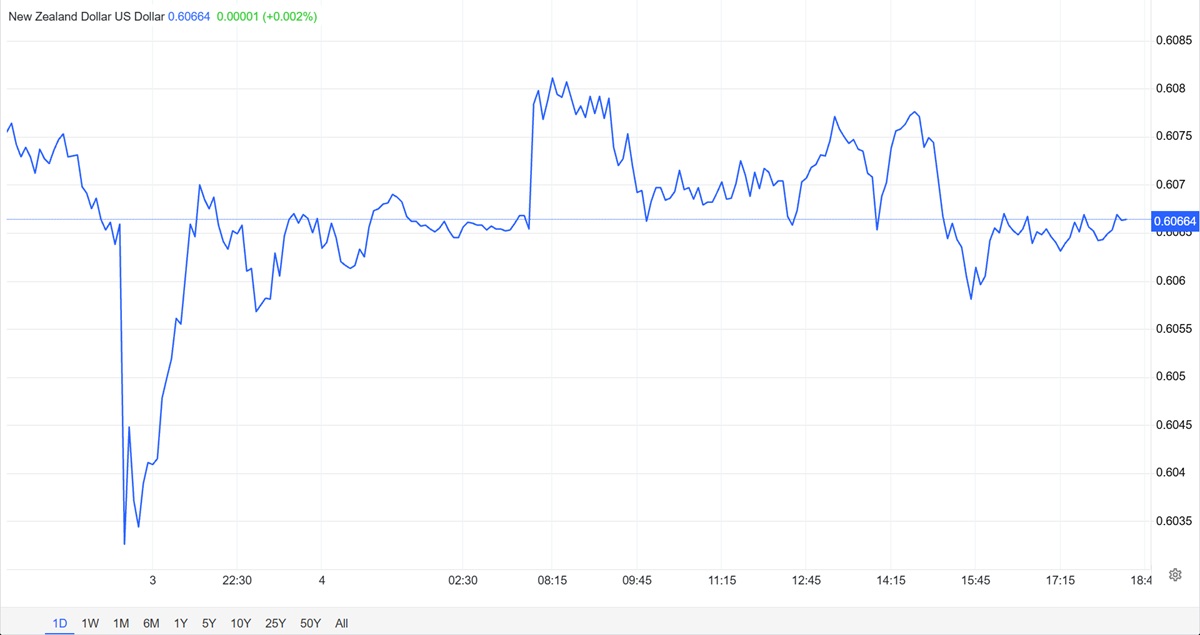
The USD to NZD currency pair has recently drawn significant attention from forex traders, as the New Zealand dollar (NZD) demonstrates renewed strength following a period of consolidation. After briefly touching the 0.6030 area earlier in the week, the Kiwi has rebounded steadily, now hovering around the 0.6080 mark during European trading hours on Friday. This positive momentum signals the potential end of a two-day pullback, driven by a combination of macroeconomic factors and shifting market sentiment.

The US dollar (USD) has shown signs of weakening in recent sessions, despite the release of stronger-than-expected non-farm payroll data on Thursday. While initial market reaction suggested a reduced likelihood of a July rate cut by the Federal Reserve, investor focus quickly shifted to broader fiscal concerns in the United States. Worries surrounding long-term debt sustainability—fueled by aggressive tax cuts and increased federal spending—have placed the dollar under renewed pressure.
This shift has benefitted higher-yielding and risk-sensitive currencies such as the NZD, providing tailwinds for the USD to NZD exchange rate. With the dollar on the defensive, investors appear more willing to rotate capital into currencies backed by stable central bank policy and favourable external demand.
 Beyond dollar dynamics, broader risk appetite has also played a key role in NZD's recovery. The global market mood remains relatively optimistic, diminishing the appeal of the traditionally safe-haven USD. As risk sentiment improves, currencies like the New Zealand dollar—closely tied to global trade and commodity markets—tend to outperform.
Despite lingering concerns about global trade policies, especially those linked to former US President Donald Trump's legacy, traders seem cautiously optimistic. The NZD's status as a proxy for Asia-Pacific growth has further strengthened its position, particularly in light of upcoming economic data from China.
While the USD to NZD pair shows signs of upward movement, the outlook is tempered by seasonally low trading volumes due to the US holiday period. Many investors are opting to remain on the sidelines, awaiting clearer direction from key economic events scheduled for next week.
Among the highlights are China's inflation data—a crucial barometer of regional demand—and the Reserve Bank of New Zealand's (RBNZ) policy meeting on Wednesday. Both events could provide decisive direction for the NZD, particularly if inflationary pressures in China show signs of recovery or if the RBNZ delivers a more hawkish-than-expected stance.
From a technical standpoint, the pair's rebound from the weekly low at 0.6030 and its advance towards the 0.6080 zone suggests a potential resumption of bullish momentum. The two-day dip appears to have been a corrective pullback rather than the beginning of a deeper decline. Should USD softness continue and risk appetite remain intact, further gains in the USD to NZD pair remain possible, with 0.6100 and 0.6130 emerging as key resistance levels.
However, traders should remain mindful of headline risk, particularly as markets continue to digest central bank commentary and global macroeconomic data.
In summary, the USD to NZD currency pair has found renewed strength amid a softer US dollar and an uptick in global risk appetite. While fiscal concerns in the US and reduced demand for safe-haven assets have weighed on the dollar, the NZD continues to benefit from its sensitivity to regional growth and commodity flows.
Looking ahead, the focus will turn to next week's data releases, particularly from China and New Zealand. These events could prove pivotal in determining whether the Kiwi can extend its recent gains or whether caution will once again dominate market behaviour. For now, the balance of risk appears tilted in favour of NZD strength, suggesting the path of least resistance remains upward—at least in the short term.
Disclaimer: This material is for general information purposes only and is not intended as (and should not be considered to be) financial, investment or other advice on which reliance should be placed. No opinion given in the material constitutes a recommendation by EBC or the author that any particular investment, security, transaction or investment strategy is suitable for any specific person.