Published on: 2025-05-13
The US dollar to Australian dollar (USD to AUD) exchange rate is a key metric for traders, travellers, and businesses alike. Over the past several years, the currency pair has experienced significant swings, reflecting global economic shifts, commodity cycles, and changing monetary policy.
In this article, we highlight the biggest highs and lows for USD to AUD in recent years and explore the factors behind these dramatic moves.
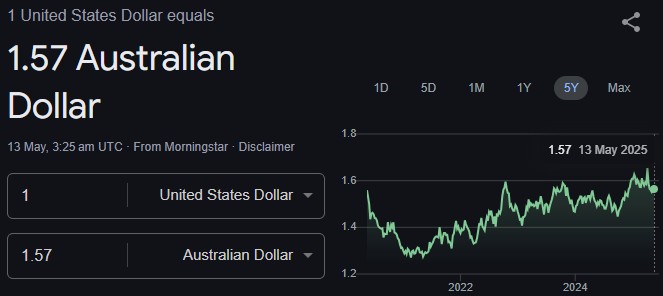
2020–2025: Volatility Amid Global Change
The last five years have seen the USD to AUD rate fluctuate in response to pandemic disruptions, inflation shocks, and policy changes in both the US and Australia.
Highest USD to AUD (recent years):
The exchange rate peaked at 1 USD = 1.67964 AUD, according to XE historical data. This marked a period when the US dollar was particularly strong against the Aussie dollar, often corresponding with global risk aversion and strong demand for the US dollar as a safe haven.
Lowest USD to AUD (recent years):
The pair hit a low of 1 USD = 1.44533 AUD, reflecting periods when the Australian dollar gained strength, often due to rising commodity prices or positive economic data from Australia.
2024–2025: A Closer Look
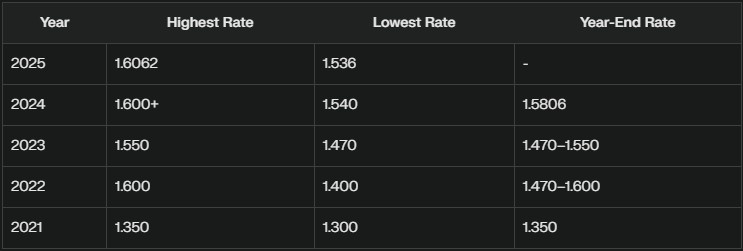
2024 Year-End: The rate closed at 1 USD = 1.5806 AUD on 31 December 2024.
2025 Highs: In early 2025, the rate reached 1 USD = 1.6062 AUD in January, before easing back to 1 USD = 1.5917 AUD by the end of April.
Recent Lows: In May 2025, the rate briefly dipped to 1 USD = 1.536 AUD on 6 May, before rebounding to 1 USD = 1.572 AUD by 12 May.
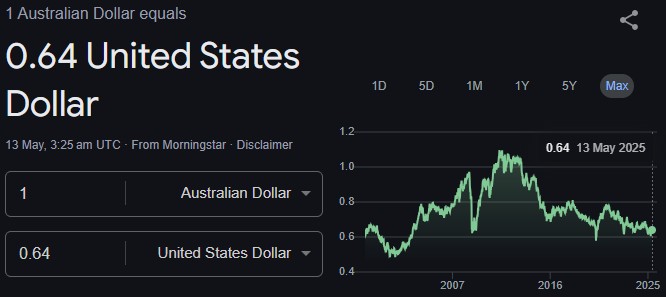
When viewed in reverse (AUD to USD), the Australian dollar's annual average against the US dollar has shifted from 0.66 in 2023 to 0.63 in 2025, with a low of 0.60 and a high of 0.65 so far this year.
1. Commodity Prices
Australia's economy is heavily reliant on commodity exports, particularly iron ore, coal, and gold. When global commodity prices rise, the Australian dollar tends to strengthen, pushing the USD to AUD rate lower. Conversely, falling commodity prices often weaken the AUD.
2. Interest Rate Differentials
The gap between US Federal Reserve and Reserve Bank of Australia (RBA) interest rates is a major driver. When US rates rise faster than Australian rates, the US dollar attracts more capital, strengthening against the AUD.
3. Global Risk Sentiment
The US dollar is considered a “safe haven” currency. During global uncertainty or financial market stress, investors flock to the USD, causing the USD to AUD rate to rise. In calmer times, the AUD can recover as risk appetite returns.
4. Economic Data and Policy
Key data releases-such as GDP growth, employment numbers, and inflation-in both the US and Australia can trigger sharp moves in the exchange rate. Central bank policy shifts, especially unexpected rate hikes or cuts, also play a crucial role.
Trends and Outlook
2020–2021: The pandemic's onset saw the USD surge against the AUD as global markets panicked, but stimulus and commodity booms helped the AUD recover.
2022–2023: Volatility persisted with inflation and central bank tightening, but the AUD found support from strong export demand.
2024–2025: The US dollar regained strength amid renewed global uncertainty and rising US interest rates, pushing the USD to AUD rate to multi-year highs before easing in May 2025.
The USD to AUD exchange rate has experienced notable highs and lows in recent years, shaped by global events, commodity cycles, and central bank policies.
For traders, investors, and anyone dealing with US or Australian dollars, understanding these trends is essential for making informed decisions in a dynamic currency market.
Disclaimer: This material is for general information purposes only and is not intended as (and should not be considered to be) financial, investment or other advice on which reliance should be placed. No opinion given in the material constitutes a recommendation by EBC or the author that any particular investment, security, transaction or investment strategy is suitable for any specific person.

EBC Financial Group is a co-brand shared by a group of entities
including:
EBC Financial Group (SVG) LLC is authorized by the St.Vincent and the
Grenadines Financial Services Authority(SVGFSA),and the company
registration number is 353 LLC 2020, with registered address at Euro
House, Richmond Hill Road, Kingstown, VC0100, St. Vincent and the
Grenadines.
Other Relevant Entities
EBC Financial Group (UK) Limited is authorised and regulated by the
Financial Conduct Authority. Reference Number: 927552. Website: www.ebcfin.co.uk
EBC Financial Group (Cayman) Limited is licensed and regulated by the
Cayman Islands Monetary Authority (Number: 2038223). Website:
www.ebcgroup.ky
EBC Financial (MU) Limited is licensed and regulated by the the
Financial Services Commission, Mauritius (License Number GB24203273)
with registrated address at 3rd Floor, Standard Chartered Tower,
Cybercity, Ebene, 72201, Republic of Mauritius. Website for this entity
is maintained separately.
EBC Financial Group (Comoros) Limited is authorised by The Autonomous
Island of Anjouan, Union of Comoros Offshore Finance Authority with
License number L 15637/EFGC, with registered office address at Hamchako,
Mutsamudu, Autonomous Island of Anjouan, Union of Comoros.
EBC Financial Group (Australia) Pty Ltd (ACN: 619 073 237) is authorised
and regulated by the Australian Securities and Investments Commission
(Number: 500991). EBC Financial Group (Australia) Pty Ltd is a related
entity of EBC Financial Group (SVG) LLC. The two entities are managed
separately. The financial products and services offered on this website
are NOT provided by the Australian entity and no recourse against the
Australian entity is available.
EBC Group (Cyprus) Ltd, faciliates payment services to the licensed and
regulated entities within the EBC Financial Group strucutre, registered
under the Companies Law of Republic of Cyprus with the number HE 449205,
registered office address at 101 Gladstonos, Agathangelou Business
Centre, 3032 Limassol, Cyprus.
Business Address: The Leadenhall Building, 122 Leadenhall Street, London, United Kingdom, EC3V 4AB. Email Address :cs@ebc.com . Telephone : +44 20 3376 9662
Regional Restrictions:
EBC does not offer any services to citizens and residents of certain
jurisdictions including: Afghanistan, Belarus, Burma (Myanmar), Canada,
Central African Republic, Congo, Cuba, Democratic Republic of the Congo,
Eritrea, Haiti, Iran, Iraq, Lebanon, Libya, Malaysia, Mali, North Korea
(Democratic People's Republic of Korea), Russia, Somalia, Sudan, South
Sudan, Syria, Ukraine (including Crimea, Donetsk, and Luhansk Regions),
the United States, Venezuela, and Yemen.
Any Spanish on this website is for LATAM only and is not designated for
anyone in European Union or Spain For more information, please check out
our FAQs.
Any Portuguese on this website is for Africa only, and is not designated
for anyone in European Union or Portugal or Brazil. For more
information, please check out our FAQs.
Compliance Disclosure:The website can be accessed globally and is not specific to any entity. Your actual rights and obligations will be determined based on the entity and jurisdiction that you choose to be regulated.There may be local laws and regulations which prohibit or limit your rights to access, download, distribute, disseminate, share or otherwise use any or all of the documents and information published on this website.
Risk Warning: Trading Contracts for Difference (CFDs) are complex financial instruments and come with a high risk of losing money rapidly due to leverage. Trade on margin carries a high level of risk and may not be suitable for all investors. Before deciding to trade Forex and CFDs, you should carefully consider your trading objectives, level of experience and risk appetite. The possibility exists that you could sustain a loss of some or all of your initial trading capital. We recommend that you seek independent advice and ensure you fully understand the risks involved before making any investment decision. Please read the relevant risk disclosure statements carefully before trading.