Published on: 2025-07-14
Gold and platinum both hold key roles in the precious metals market, yet their trading dynamics diverge sharply. Today's relative price, liquidity, and underlying drivers present distinct opportunities—especially for active traders looking to capitalise on volatility, macro shifts, and sector-specific trends.
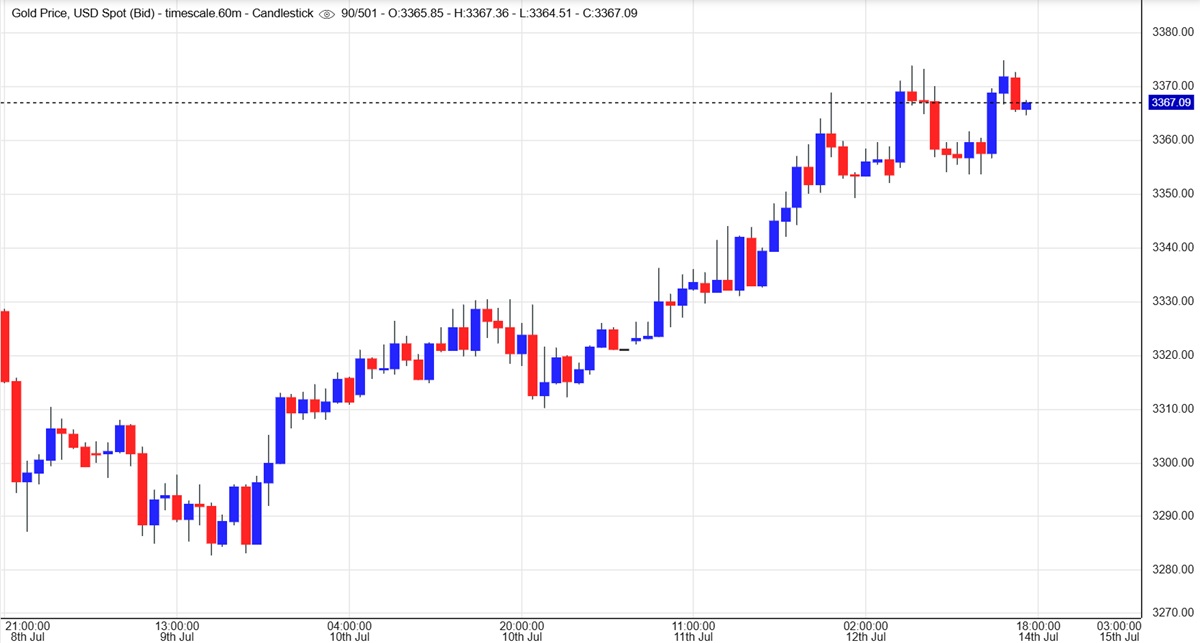
As of July 14. 2025:
Spot gold is trading at approximately US $3.355.95 per oz (bid/ask range ~US $3.354.77–$3.376.54).
Spot platinum is around US $1.418.50 per oz (+ US $2.50 or +0.17%).
This sets the gold–platinum ratio at roughly 2.37. meaning one ounce of gold buys 2.37 ounces of platinum—a level well above the 20‑year average of 1.29 and the +1σ mean (~1.91), suggesting pronounced divergence .
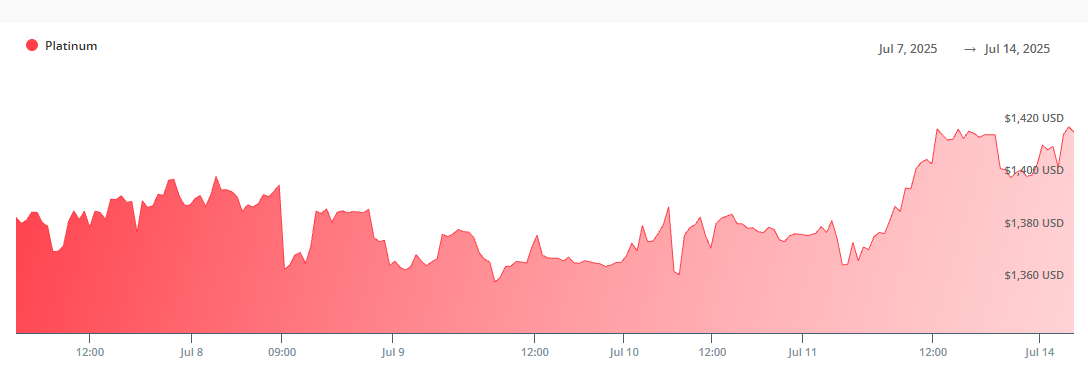 Gold remains the core hedge in trading strategies, reacting sharply to inflation data, interest rate expectations, and global risk sentiment. Its deep liquidity ensures quick execution during volatility spikes.
Platinum is not a traditional hedge. Its price reacts to industrial growth signals—especially auto sector data and energy transition cues (hydrogen, catalytic regulation). Its lack of inverse correlation to markets makes it unsuitable for macro protection, yet it can offer asymmetric upside in thematic trades.
Trader's takeaway: Use gold for macro hedging and volatility setups. Use platinum selectively in thematic or cyclical plays, not as a hedge.
Platinum's price is dominated by its industrial dependence:
Auto demand (catalytic converters in petrol/diesel vehicles)
Potential in hydrogen fuel cells
Gold enjoys broad demand stability:
Jewellery (major share)
Central bank holdings
Institutional investment (ETFs, bars, coins)
Minor industrial use (electronics)
Trade insight: Watch auto/manufacturing PMI and EV/hydrogen policy announcements—these can trigger sharp platinum moves. Gold trades are broader, with trade-offs tied to FX, monetary policy, and geopolitical headlines.
Gold: Superior liquidity with tight spreads, massive futures/options turnover, and 24/5 accessibility. Ideal for scalping, high-frequency trading, layered entries, and firm exits.
Platinum: Smaller market, wider spreads, and slower response times. Yet, this lower efficiency yields occasional short-term arbitrage or mean-reversion opportunities for skilled traders.
Tactical edge: Gold for smooth, scaled-in trades; platinum for thematic alpha trades with appropriate risk controls.
While most traders operate via derivatives:
Gold holds universal physical appeal—with standardised bars, coins, and resilient secondary market pricing.
Platinum, being less standardised, can introduce wider premiums/discounts and fewer dealer options—raising costs for physical arbitrage or allocated holdings.
For physically weighted positions, gold remains more cost-efficient and simpler to manage, but platinum may offer richer opportunities in niche arbitrage.
Pre-2008. platinum typically traded at a premium to gold (ratio
Post-financial crisis, gold surged while platinum lagged; the ratio inverted.
Today, with the ratio ~2.37. the gap is near record levels.
Trading strategies include:
Ratio mean-reversion: Short gold, long platinum when ratio spikes.
Momentum trades: Long platinum during auto/data-driven breakouts.
Macro hedges in gold: Pre-US CPI/Fed meetings or safe-haven spikes.
Gold acts as the cornerstone hedge: liquid, responsive, low risk for macro exposures.
Platinum offers opportunistic risk, driven by sector news, manufacturing cycles, and green transition playbook.
Best practice: Combine both—gold for defensive positioning and platinum for aluminium-level alpha. The present ratio, liquidity profiles, and macro backdrop suggest platinum is undervalued, while gold remains the reliable hedging bucket.
Disclaimer: This material is for general information purposes only and is not intended as (and should not be considered to be) financial, investment or other advice on which reliance should be placed. No opinion given in the material constitutes a recommendation by EBC or the author that any particular investment, security, transaction or investment strategy is suitable for any specific person.