Published on: 2025-08-29
Updated on: 2025-09-02
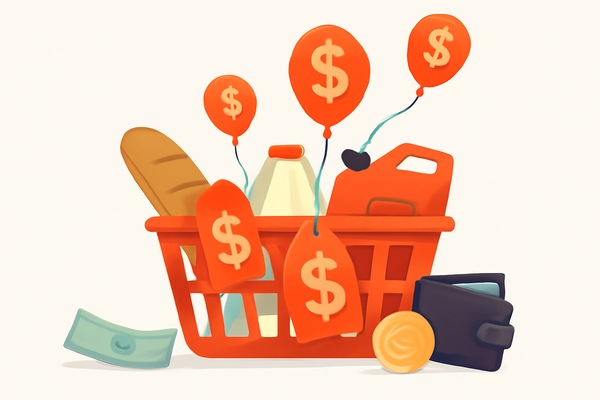
Inflation is the overall increase in prices across the economy, meaning that each dollar buys you less over time. It's tracked as an annual percentage, such as 3% or 6% a year, and is commonly measured through the Consumer Price Index (CPI) or Producer Price Index (PPI). During inflation, the cost of goods and services—from bread to cars—moves upwards, affecting everyone's purchasing power.
Reduces Money's Value: Rising prices erode the real value of cash savings and fixed income.
Influences Profit and Strategy: Companies may face higher input costs, possibly squeezing profits if they can't raise prices. Traders watch inflation to anticipate moves in stocks, bonds, forex, and commodities.
Central Bank Actions: If inflation is too high, central banks raise interest rates, making borrowing costlier and potentially cooling markets.
Market Volatility: Inflation surprises trigger sharp reactions in asset prices. Even 'good' inflation can spark volatility if it's higher or lower than expected.
Say you invest $10,000 in government bonds yielding 2% per year. If inflation is 4%, your real return is negative—you lose purchasing power. Alternatively, if you buy shares in a supermarket chain that can raise prices in line with inflation, the value of your investment might keep pace, or even grow, as costs and sales rise together.
If a country's inflation jumps unexpectedly, the national currency will typically weaken, as foreign investors seek assets in lower-inflation economies. For example, when US inflation rose sharply in 2022 and 2023, the US dollar initially strengthened due to higher interest rates, but the stock market saw pressure as traders worried about future company profits.
Thinking all inflation is harmful: Steady, moderate inflation encourages spending and investing, which supports economic growth.
Assuming all assets hedge inflation: Not all stocks, bonds, or real estate keep pace, especially if inflation outpaces wage growth or triggers rate hikes.
Ignoring global impact: Inflation in one country often affects global supply chains, trade balances, and investment flows.
Believing inflation is always obvious: Many costs (like housing or medical care) may rise faster than headline inflation, impacting households unevenly.
Deflation: A period of falling prices, often linked to economic downturns, causes cash to gain value but can harm growth and jobs.
Stagflation: Simultaneous high inflation and stagnant growth—a difficult scenario for central banks, last seen in the 1970s.
Hyperinflation: An extreme and rapid rise in prices, destroying currencies and savings (e.g., Zimbabwe, Venezuela).
Real Return: The gain on an investment after adjusting for inflation—a key figure for long-term planning.
Demand-Pull: People and businesses spend more than the economy can produce, “pulling” prices up (e.g., post-lockdown spending booms).
Cost-Push: Higher costs for materials or wages “push” prices up throughout the economy (e.g., oil shocks cause transport costs to rise broadly).
Expectations: If people expect higher prices, they negotiate for higher wages, which then feeds inflation.
Supply Chain Shocks: Disruptions—like war or pandemic—can choke supplies, driving up prices rapidly.
Winners:
Borrowers: Repay loans with “cheaper” future dollars.
Commodity Investors: Gold, oil, and farmland often outperform when inflation is high.
Flexible Businesses: Companies that can adjust prices quickly (utilities, some consumer staples).
Losers:
Savers: Bank savings and bonds lose real value if rates don't keep up with inflation.
Fixed Income Earners: Pensions or contracts not adjusted for inflation buy less each year.
Importers: Currency weakness increases the costs of importing goods.
Stocks: Growth stocks may suffer if inflation spikes and rates rise, since future earnings are discounted more harshly. Value stocks or those with “pricing power” (e.g., utilities) may shine.
Bonds: Inflation erodes the value of fixed interest payments, leading to falling bond prices.
Currencies: High domestic inflation generally weakens a currency against global competitors—forex traders watch inflation data releases closely.
Commodities: Many investors diversify into commodities as a direct inflation hedge, especially in uncertain times.
Advanced market participants:
Monitor granular inflation metrics (core CPI, PPI) for hidden signals.
Use complex derivatives (interest rate swaps, options) to hedge inflation-sensitive portfolios.
Study central bank communication for forward guidance on inflation policy.
Model the impact of inflation on cash flow, sector dynamics, and capital allocation—sometimes positioning for both rising and falling inflation scenarios.
Swiftly react to data releases: financial markets can reprice dramatically on inflation surprises, so institutional desks prepare scenarios and execute trades in seconds.
Inflation is neither entirely good nor bad for markets—it adds nuance, challenge, and opportunity for prepared traders and investors. It shifts the balance between risk and reward, altering which strategies succeed across different assets and global cycles. Savvy market participants adapt to inflation's changing tides, using careful analysis to protect their capital and seize emerging trends. Ultimately, inflation rewards flexibility, informed action, and a deep understanding of how shifting prices ripple through every corner of the economy.
Disclaimer:
This material is for general information purposes only and is not intended as (and should not be considered to be) financial, investment or other advice on which reliance should be placed. No opinion given in the material constitutes a recommendation by EBC or the author that any particular investment, security, transaction or investment strategy is suitable for any specific person.